Author Archives: connieswaim

Unknown's avatar

About connieswaim

Dog trainer, writer, reader, lover of fine wine

Is your dog stubborn?

“My dog is stubborn.”

“My dog knows ‘sit’ but he only does it when he wants to.”

‘My dog doesn’t listen.”

These are all common sentences I get from clients. They want clear communication with their dog, and they are not achieving that so it must be the dog’s fault.

What we think of as stubborn or a dog that is mad at us is often a dog that just has no idea what we want. We may think our instructions are clear. But, if the creature we are speaking to doesn’t understand the instructions, then it appears the creature is uncooperative.

Let me share my experience at the office of an eye surgeon. I have a macular hole in my right eye. This is a small break in the macula. The macula provides the sharp, central vision we need for reading, driving, and seeing fine detail. To correct this issue, surgery is needed in which a gas bubble is inserted in my eye to stabilize the hole.

I’m already stressed just being there. The thought of surgery is scary and thinking about someone cutting into my eye and inserting a gas bubble is causing me much angst.

The eye technician had to do many tests before I met with the specialist. I am certain this woman went home and complained about how uncooperative I was and how I could not follow even the simplest of instructions. I am sure she said, “she knew what I was asking her to do, she just didn’t do it.” Sounds familiar right?

She also most likely called me angry as I ended up saying something to her in a harsh voice, which is totally not like me. I am generally very cooperative and eager to please. I want people to like me.

How did this happen?

I was already stressed walking into the room. My brain was going a hundred miles an hour thinking of all the “what ifs.” I was having difficulty processing the instructions for the tests because I was having difficulty keeping my focus and not thinking “what if.” There were a lot of tests requiring precise instructions in order to do them correctly. I am an A student. I want to ace any test. But I wasn’t sure what the scoring was or what the tests were showing, so I had no idea if I was doing the tests correctly or if they were showing something bad about my eyesight. What if I was going blind?

The longer this went on, the more difficult it was for me to process the information and to understand the nuances of the technician’s language.

My right eye can’t see well at all right now and it stresses me. She was trying to find out exactly what I could see by showing me lines of letters. I couldn’t see the letters clearly enough to tell what they were. I explained that when I had been to my own eye doctor a few weeks ago I had to get to the second largest line, but instead of starting there, she went up from the bottom and I kept having to say I couldn’t make out the letters clearly. Every line was “what about this line?” Finally, she said “are you sure you can’t make out anything on this line?” I wanted to please her, so I squinted hard and said “maybe an A.” She said, “good can you read anything else on that line?” I was encouraged by the “good”, so I ventured “L.”

“I’ll take it,” she replied.

I let out a huge sigh. I got it right. She was pleased with my performance.

Then she said again, “I’ll take it.” Now I’m confused. The second time she said, “I’ll take it”, her voice sounded harsh. I perceived her as unhappy with me. What had I done wrong? She reached her hand toward me, which made me flinch back and said “I’ll take it” in very enunciated language as if maybe I just was not understanding her. Then she said, “I’ll take the glasses.” I was using what could be described as opera glasses to look at the lines on the screen. The device covered one eye, so the exposed eye was what was taking the test. When she said “I’ll take it” she meant she wanted me to give her the glasses.

I could tell by her body langue that she was super irritated with me, which stressed me out even more. She gave me back the device and did another test with it. She asked me to flip down a tab on the side. Her only instructions were “see the tab on the side? Flip it down.”

I did that. It turns out there were two ways I could have flipped it down; to either the right or the left. I chose right. She said, “Flip it down so it covers the eye hole.” Yikes, I was doing everything wrong. I thought I understood what she was asking me to do, but I clearly wasn’t.

Finally, we got to the questions portion of the testing. I thought I would surely do better on this.

Question one: When did you have your Lasik surgery?

Answer: I am not 100 percent sure, 8 to 10 years ago.

Question: You don’t know when you had the surgery?

Answer: no.

Question Who did the surgery?

Answer: I can’t remember.

Question: you have no idea who did your surgery?

Answer: No, I only met them once.

What my brain is doing: Oh my God. I can’t remember. By her tone she is implying I should remember, and other people remember so I must be stupid. Am I stupid? Do I have a memory issue? Am I going blind and having a memory issue?

Question: Did you bring you reading glasses?

Answer: no

Question: You did not bring your reading glasses?

Answer: I followed every instruction I was given. My instructions were to bring my photo ID, my insurance card and my sunglasses. I was not asked to bring my glasses.

I said the above in a much harsher tone than I would normally use. I snapped at this woman. I immediately gave a weak smile toward her and dipped my head down. I wanted her to know I didn’t want to hurt her or take this argument further. I needed her to just back off a bit.

It was now time for the eye drops to dilate my eyes. Have you seen the movie A Clockwork Orange? There is a scene where a man has his eyes forced open and must watch horrible things. He can’t close his eyes. Her fingers were like that. My head was pushed back in a head rest and she had her fingers vice gripping my eyes open and dropping eye drops in. She got a second bottle and did more drops and as soon as the second liquid hit my right eye I jumped and took a deep breath because it hurt.

“That second one may sting” she said as she walked away.

If two people speaking a common language can’t even understand each other, think about what your dog must be experiencing if you are asking him to do something he really doesn’t understand or doesn’t understand in the context you are asking the question.

You ask the dog to sit, he doesn’t do it, so you ask him again as if maybe he just wasn’t understanding you the first time. Like the technician questioning me again every time I answered no when she thought I should be saying yes. That was frustrating and it is frustrating for your dog as he understands he got something wrong by your body language and voice. He isn’t being willfully disobedient. He is not sitting because he didn’t process the information in the way you think he did. Maybe you haven’t explained the question as clearly as you think you did or maybe there is so much going on around you, the dog isn’t able to hear your question the same way he might when nothing else is going on around you.

If your dog walks away from you or snaps or growls at you. He is not being a bad dog. He is being a very frustrated or very scared dog. If you keep scaring or frustrating him, he won’t get better, he will get worse. Instead, take a step (or 10) back and find out where your dog can work with you again. Can you make the problem easier for the dog to understand?

Often people say, “he knew he was wrong because he immediately came back and licked my face.” This is often an appeasing type of gesture. The same ones I gave to the technician: a smile and loose body language. It is the dog’s polite way of saying he doesn’t want this to escalate, but he needs you to know that this is all very stressful and to please stop doing whatever it is.

Then what if you punish the dog by doing something that hurts or scares him such as yelling at him, hitting him or pushing him? Kind of like me getting the scary eye drops I didn’t know where going to hurt. At that point I was done trying to please this woman or take her stupid tests. I wanted out of there.

Instead she left me in a time out. She said the dilation would take about 10 minutes and then the doctor would be in to see me. I tried a weak smile as she left, and she looked back and said, “you have to close your eyes for the dilation to really work” and shut the door.

I am now in a room with my eyes shut freaking out over the last half hour of stressors. I could certainly use something to occupy my mind. Maybe some music? Or someone periodically coming in to ask how I am doing. Was there a time limit I was supposed to keep my eyes closed and how do I know when it is up if I can’t see a clock?

By the time the eye doctor entered the room, I had to use all my will power not to either bolt out the door or burst into tears.

And he asks me AGAIN who did my Lasik surgery and when it was. I STILL don’t know the answer. And it turns out to have absolutely nothing to do with my macular hole. He told me that was just bad luck and old age.

He takes as bunch of equipment and puts it close into my face and starts calling out numbers to another technician sitting in a corner and she starts inputting those numbers. I don’t know what the numbers mean. Are they good numbers or bad numbers? I am practically shaking by the time he is done and says, “well other than the hole, your eyes are healthy.”

By the time we get to the point of setting up a surgery I am so ready to leave that I practically run out the door.

I don’t want to go back. I don’t want to work with those people again. They gave me no incentive to cooperate. Their questions were not clear (to me) and I repeatedly was exposed to pain or uncertainty.

That same day I worked with a dog that had a very hard time concentrating. I was trying to see if he could target my hand. He did great at first until he suddenly started backing away from me every time, I presented my hand. The more I worked with him, the farther he backed away. No matter how I asked the question “do you want to touch my hand?” he said, “this makes me nervous.”

I learned the dog had gone through repeated medical treatments in which the owner had used treats to get the dog to come into stressful situations.

I immediately stopped asking the dog to target my hand. Instead I tossed out a toy and rewarded him if he looked at the toy, then rewarded him for stepping closer to the toy and then touching the toy. In less than 5 minutes he was repeatedly touching his nose to the toy. So, he understood  we were playing a game and what the rules were, but he was telling me he did not trust the outcome of the game when I wanted him to touch my hand. He had already learned that some body positions meant something scary was about to happen to him.

The next time you think, “my dog is bad” or “my dog is stubborn” consider finding a new way to ask the dog the question you think he is not answering correctly. Are you sure he understood the question? Did a lot of stressful things happen to him that day? Is there a lot going on in the environment around you? You may be 100 percent sure the dog understood what you meant but if you get the wrong answer, the dog is most likely answering the question he thought you asked.


You can make that vet visit less stressful

Taking your pet to the veterinarian is stressful. The more serious the issue, the more likely you are to be worried. Your dog can easily pick up on your stress, but he won’t understand what the cause of that stress is all about. He could; however, begin to associate the veterinarian’s office as the place your stress increases. This may make your dog become more agitated about going to the place that makes your nervous.

Now, think about walking through the vet’s doorway from your dog’s perspective. Your dog’s nose is powerful. Your dog possess up to 300 million olfactory receptors in his nose, compared to about six million in your nose.  And the part of a dog’s brain that is devoted to analyzing smells is, proportionally speaking, 40 times greater than ours.

My guess is a dog walks into a vet’s office and immediately wonders why it smells scary. He can smell other dogs who are scared. He may smell a deceased animal. He will smell other animals that are not dogs. There will be medical smells. Your dog will know if other dogs before him were having a bad day.

If a dog (or any animal) is continually stressed every time he visits the vet, he could become more and more anxious. That could lead to struggling when examined, growling, snapping or worst-case scenario biting someone. Some clients become so embarrassed by their dog’s behavior, they stop going to the vet. This is never a good solution. Or the vet says the dog can’t come back due to safety concerns or states the dog is aggressive. Some owners are told their dog would be better off if it were euthanized.

Let’s face it; there are a LOT of emotions on both sides of the exam table. Veterinarians and their staff are often in tiny rooms with anxious animals and most of them have been bitten or at least threatened numerous times in their careers. From personal experience, I can say once you have been bitten by a dog, it is very difficult to put that aside.

While veterinarians get a wonderful education in veterinary medicine; not all of them get a good education in animal behavior and what drives animals to do different things. They may not get a lot of course work in animal stress signals or how to make the world less stressful for their patients.

Luckily, the world is changing. Veterinarians and their staff members are now getting more and more education on how to make an animal’s experience less stressful. You are now seeing more and more veterinarians’ offices using words like “low stress,” or “fear free.” There are now organizations which will certify a practice or an individual in that practice as having completed course work to learn best practices in how to reduce the stress of an office visit.

I am not going to go into the differences between the certifications. The two which seem to have the most followers are the Fear Free Certification Program and the Low Stress Handling University. The American Animal Hospital Association (AAHA) announced the Fear Free Certification Program at its annual conference in 2016. The Low Stress Handling is based on the work of the late Dr. Sophia Yin.

“Fear Free is all about creating an environment that helps reduce the feelings of fear, anxiety, and stress in our patients by promoting a considerate approach and gentle control techniques in a calming environment, which results in an experience that is much more rewarding and safe for our patients, our clients, and the entire veterinary health care team,” said Dr. John Talmadge. Talmadge announced the new certification program at the AAHA conference. The protocol was developed by Dr. Marty Becker.

I urge all of my clients who have dogs experiencing serious behavior issues at a veterinarian’s office to ask their vet about ways to reduce the animal’s stress. Ask your vet if he or she knows about the above organizations. If he or she does not, ask if they can refer you to a practice where the guidelines are being implemented. Search for veterinarians, vet techs or entire practices in your area that are advertising Fear Free or Low Stress environments.

Unfortunately, many people live in areas where this movement has not caught on. That doesn’t mean you can’t be proactive about how your pet is treated when he visits the vet’s office. It is tough to do though. We are taught to respect people who are in authority and when you are at a vet’s office, that person is the authority. It can be difficult to speak up. When my youngest dog, Falcon, was 4 months old, the veterinarian stopped me from offering treats to him while he was getting puppy shots. The vet said I had a German shepherd and I couldn’t “coddle” them or they would grow up to be “mean.” He said I had to “show the dog who was boss.” I would like to say I calmly explained how outdated his views were and asked him to please step away from my puppy. But, I didn’t to my very GREAT regret.

Instead I never went back to that vet. Of course this is not helpful to him or any other clients that he sees. Don’t be like me.

Tips for dog owners:

Take treats to your veterinary visit and don’t let anyone talk you out of giving the treats to your pet (unless of course there is a medical reason the animal can’t have food). Think big such as chicken, hot dogs or cheese. Take a can of cheese whiz. You need your dog to think super amazing food falls from the sky when he is at the vet’s office.

Be proactive and let your vet know if your pet has places he does not like being touched. If your dog is stressed when he sees other dogs or cats, ask your vet if there is a different door you can come in, so your dog doesn’t have to see the other animals in a waiting room.

If your vet says your dog must be muzzled, get your own basket muzzle and train your dog to LOVE wearing it prior to ever going to the vet’s office. Then muzzle your dog yourself before going into the exam room.

Do not let anyone drag your dog by his leash or by his collar to force him to do something such as getting up on the scale for a weight check. Show your dog some treats and see if he will willingly step on the scale or ask if the weight is important for that visit and just skip it.

If there are more than three people in the room (including you) see if the extra people can step outside. Ask people not to corner your dog, but instead have them toss some treats to the dog (do not have the treats in the hand and force the dog closer). This may make the dog come over on his own and relax more.

If your issue is not related to your dog’s body temperature, ask if they can skip the rectal thermometer or ask if the vet can get a different type such as one that goes into the dog’s ear instead.

Buy a bandana and spray it with ADAPTIL (also seen as DAP) about 10 minutes before your vet visit and then put the bandana around the dog’s neck. Consider spraying your own clothes as well. ADAPTIL is a calming product that has been shown to be extremely effective in calming some dogs down. Vet offices that have gone Low Stress or Fear Free generally have ADAPTIL diffusers going all of the time.

If your dog becomes agitated, especially if he is growling or seriously struggling, find out if the appointment can be postponed or moved to a new location. Sometimes taking a dog to a larger area will help. Try moving the dog to the floor if he is on an exam table, or if he is on the floor try moving him to an exam table (with some type of non-slip covering). Obviously, if you are experiencing an emergency, you will need to do whatever you need to in order to ensure your pet is ok.

Once your dog’s exam is over, ask the staff to stay for a few extra minutes and just calmly toss the dog some treats. That way the dog may realize great things happen after the scary things.

Tips for Veterinarians and staff

Understand animal communication and stress indicators. Your patients can’t talk to you in an easy to understand verbal way. But you can learn to read their body language better. There are many simple things you can do such as not making direct eye contact or not trying to be a “friend” to the dog by trying to pet it or love on it.

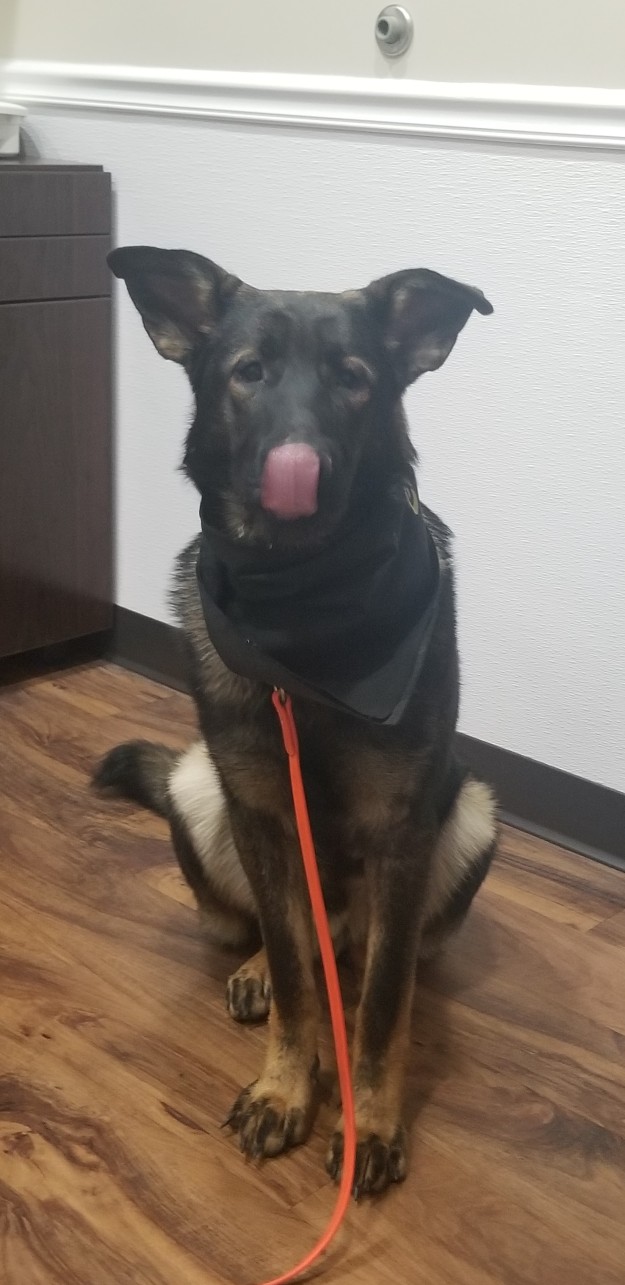
falcon lip lick

Lip licking can be a big sign of stress in a dog. Know how dogs communicate their anxiety in order to help them be less stressed during a vet visit.

Don’t corner scared animals or try and force them to do something. If you take a few minutes to see if the animal will cooperate then the next time that animal visits your job will be easier and it will make up for the extra time you are spending.

If you do not have animal treats (and I mean good ones and not the icky dry dog biscuits) in your exam and waiting rooms, stop what you are doing right now and get some.

Take a good look at your waiting room. If you have security cameras in the room review the footage and see what is happening before your patient enters the exam room. The more agitated the animal is before he even gets to see you, the more agitated he will be once in the room with you. Put up barriers or offer barriers for owners to set up between them and other pets to block line of sight. You can make inexpensive barriers out of corrugated board and tape. Have a side of your waiting area designated for cats/small pets and one for dogs so the dogs aren’t scaring the cats or becoming over aroused at seeing the cats.

What happens after the client leaves your exam? If she goes right to a counter in the middle of a crowded waiting room to pay, is that ramping up the other animals in the waiting room? Could the client pay in the exam room and walk out a different door to exit the practice?

Do an analysis on how much time you spend trying to do an exam on a scared animal or how often you or your staff are injured. Many people are resistant to a low stress handling approach because it may take more time. However, it may save you time and save you lost work due to injury.

If you can’t do one of the certifications; that doesn’t mean you can’t make things better. Reach out to the nearest board-certified behavioral veterinarian in your area and see if he or she might come and do a training course on animal behavior and stress signals.

If that isn’t possible see if there are any trainers in your area who work with serious behavior issues. Just make sure the trainer you choose is a positive, reward-based trainer only. If you need to know why, just look at the Position Statements put out by the American Veterinary Society of Animal Behavior. I have done programs for numerous veterinary practices. I have a list of veterinarians I can use as references as well. So, ask anyone you consider if he or she has references you can check for their qualifications.

I offered to go to the veterinary practice that scared Falcon and talk about canine behavior and easy ways they could change their practice to help dogs have a better experience. I offered to do this for free. No one took me up on the offer.

The better experience a pet has at the vet’s office, the more likely your pet will be to have a continued great relationship with the veterinary community. If your pet is continually stressed at the vet’s office, it is very likely your pet’s behavior will deteriorate over time.

It is in all of our best interests to ensure animals are cared for safely and humanely.

I have written a separate blog post as a companion to this one detailing my recent veterinary experiences with Falcon. I hope it will help illustrate why it is important to make your dogs experience the best one possible when at the veterinarian’s office and how wonderful it is to work with veterinarians who understand how to work with anxious pets.


Falcon’s vet visits: The good, the bad and the ugly

My youngest dog, Falcon, is 10 months old and has been seen by six veterinarians at five different practices.

He is not a huge fan of going to the veterinarian. There are many reasons he could be so stressed including an emergency vet visit at 13 weeks of age, my allowing him to be scared during a puppy shot visit and his breed. He is a German shepherd and they are by nature not always inclined to make friends instantly with strangers.

This blog post chronicles Falcon’s vet visits so far including what I did right as well as areas where I did not take appropriate action. It is a companion piece to a blog post on Low Stress and Fear Free handling.

The week after I brought Falcon home, I woke up one morning and discovered his jaw was swollen. I rushed him to the emergency vet. The vet tried to examine him, but he was extremely painful and thrashed and screamed when she tried to open his mouth. He was then sedated for x-rays. Luckily, nothing was broken. He had some abrasions on his upper and lower gums. The vet thought he may have chewed through an electrical cord, but once I got home and examined each cord in my home, it turned out that wasn’t it. He was given pain meds and an antibacterial mouth rinse for the gum irritation.

While I don’t know what happened to him, I do know that it happened at 13 weeks, which is in a critical socialization period in which puppies make important life-long connections about what is safe and what is scary.

At 4 months old he was getting one of his puppy shot boosters and the vet who saw him did not want me to use treats. He told me since I had a German shepherd I had to “show him who was boss and not coddle him.” I made a huge mistake by allowing the vet to continue with the shots rather than just walking out the door with Falcon.

falcon puppy exam table

This is the face of a puppy who is already getting worried and the vet hasn’t even stepped in the room yet. Having treats or a toy might go a long way to helping ease the puppy’s stress.

I did not see that vet again, but I did go back to that practice for the last set of shots and Falcon struggled and even growled at the vet. The vet tech tried dragging Falcon back toward her with his leash and this time I was prepared and stopped what was going on. However, I realized I had a problem.

At this point I should have been MUCH more proactive about taking him to different vet offices and making sure he had great experiences. I didn’t. I am the first to admit my dogs often suffer from lack of training because I am tired once I get home from training other peoples’ dogs. Luckily, when I took Skywalker in for shots at a different veterinarian, I was able to bring Falcon into the room with me and that vet and the vet tech tossed treats everywhere while Sky got his shots.

Around 7 months of age, I noticed that Falcon had an odd way of drinking water. He would fill his mouth with water and then extend his neck up before swallowing. He did not eat food this way. It was only when he drank water. Nothing seemed wrong with him, but it concerned me enough to take video and send it to some veterinarian friends who all agreed it didn’t look right.

I decided to make a vet appointment.

This time I choose to visit a vet who offered stress free handling. The clinic was 70 minutes from my house, but I knew the better experience would be worth it in the long run.

This practice books appointments so there are not multiple animals in the waiting room. There are separate exam rooms for dogs and cats. The dog room has an ADAPTIL infuser going and the cat room has a Feliway infuser going. Both of these products have been found to have a calming effect on each species.

falcon stressed

While lots of things were right in this visit; Falcon was still very stressed out. He would not eat any of the tasty treats offered and we ended up finding a different way to work with him using a Calming Cap.

The dog room has shelves FILLED with everything from dog biscuits to baby food. If a dog might find it appealing, it was stocked on those shelves. There isn’t an exam table in the dog room. Just a bench against the wall for the owner and a rolling chair for the veterinarian.

As I walked in the door, the receptionist immediately noticed how anxious Falcon looked and she handed me a bandana which had already been sprayed with ADAPTIL. In the exam room Falcon stayed plastered to the door with his head facing the corner. If there was an aversion behavior to be offered, he was offering it. His entire body said “Please stay away, you scare me.”

The technician walked in, avoided looking at Falcon, took down all the pertinent information and walked out. We gave Falcon half an hour to see if he would calm down and acclimate more to the room before the veterinarian entered.

I had a treat bag filled with hot dogs, which Falcon was eating if they came near him, but he would not go search for them or come to me for more. When the vet came in, he was still plastered by the door. We tried every treat on the shelf, even disgusting smelling chicken baby food. Falcon was not interested. He just wanted to leave. Luckily during the offerings of food and because he was panting so much, the vet was able to look into his mouth from a few feet away and didn’t see anything that would make him drink in his weird fashion.

However, we needed to do a blood draw just to make sure nothing unusual showed up. We had collected a urine sample before Falcon came into the exam room.

After realizing no amount of avoiding direct confrontation on the vet’s part or tasty food from the treat shelf was going to work; we went for Plan B. The veterinarian had a Calming Cap. It goes over the dogs’ eyes and while he can see light through it, he can’t really see what is happening. We also put him up on an exam table so the blood draw would be faster to get once he was calm. The Calming Cap was amazing. Once it was on Falcon stood still. I don’t think he was less stressed, but the Calming Cap prevented him from struggling and making everything much worse.

Luckily, all of Falcon’s blood work came back normal. Since the strange drinking behavior did not seem to be causing an issue; the veterinarian did not think it was something to immediately worry about. She did recommend I make an appointment with a dental specialist to see what he thought.

A month later, Falcon became ill. I drove back to the vet 70 minutes away.

On the way I stopped and bought some ADAPTIL. I sprayed the bandana I had gotten on my previous visit. Once I arrived at the office, I sprayed myself with ADAPTIL. I had a treat pouch full of cooked chicken. I walked toward the door to the clinic and Falcon stopped walking. If I tried to move forward he started struggling against the leash. I began walking up and down the sidewalk and he got lots of chicken. I would stop at the door and if he struggled, I walked on. If he was calmer chicken rained from the sky. I also switched him to a harness so there wasn’t pressure against his neck. In 10 minutes I was able to get him through the door.

I knew the vet would want a urine sample, so I asked if I could collect it myself rather than have a stranger follow my dog with a bowl.

Once in the waiting room, Falcon didn’t want to move any closer to the exam room doors. I started running up and down the lobby with him (moving parallel to the exam doors, not toward them). I got silly, talked funny, asked him to jump on chairs. Every once in awhile we would walk toward the doors and he got lots of chicken. I began to turn around and run again before he got the chance to stop and be worried. Fifteen minutes later he was able to walk into the restroom (which I was using as my pretend exam room). By the time the exam room opened up, he walked right in.

The vet tech came in and said since he was so worried, she would not exam him herself or try and take his temperature. “Why stress him with two people looking at him?” she asked. While waiting for the vet I threw chicken all over the room and had Falcon hunt for it. He was so much more relaxed this time around and he moved all around the room looking for chicken.

There was a matt in the room and I began to ask Falcon to go to the matt and get rewarded. By the time the vet walked in Falcon was quietly laying on the matt. He remained relaxed as the vet and I talked and I tossed him lots of chicken.

Before the vet examined him, I put the Calming Cap on him. The vet was easily able to do a complete exam. It was determined he had a bad tummy ache. While there we talked again about a visit to the dentist to figure out the drinking issue. The veterinarian said she would let the dentist know how stressed Falcon was so he could take that into account when he met us.

On the day of the dental appointment, I once more sprayed the bandana with ADAPTIL. I had a treat bag full of chicken and my clicker. Falcon had no issues walking into this clinic. I loved the clinic because the  waiting room uses dividers between seating areas so dogs and cats can’t see who or what is on the other side. Breaking this line of sight goes a long way toward keeping the waiting patients and their owners less stressed.

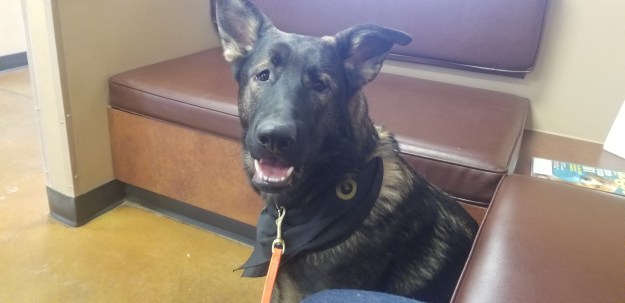
falcon relaxed

This is the day of our first visit with the dentist. Notice the barriers around the seating area so Falcon can’t see the other animals in the room. He is wearing his ADAPTIL infused bandana and he looks much happier than his previous photos.


While we waited to be called back to an exam room I spent the time training with Falcon. Keeping him occupied would mean he would have less time to worry about what was happening. We didn’t do anything difficult. If he appeared anxious, I just stopped asking for anything and waited for him to look around and then decide if he wanted to come back for more training. Soon the gaps between when he was looking around and when he was working for me were very short.

By the time we were ready for the walk to the exam room, he was relaxed. Once in the room we had more time waiting for the veterinarian. I did more training. I let him hunt for chicken on the floor. We played a game in which he got a click and treat for nose targeting various things in the room. The furniture was set up so he could easily go from a bench to the top of the exam table. I had him get off and on the table a lot as Falcon loves to climb. Then we played a game where he got a click and treat for laying on the table, then laying on his side on the table. I was teaching him to nose target my cheek when the vet walked in.

Falcon remained on the exam table and while he was a bit worried about the vet, he didn’t try to get off the table. The vet stayed across the room as we talked. Falcon got lots of treats for remaining calm. The vet was able to examine him without the calming cap this time. He could not fully examine Falcon’s mouth, but he could see into his mouth and feel around his throat and abdomen without issue.

At the end of the exam the vet said Falcon was one of the nicest German shepherds he had examined.

The vet decided he would need to sedate Falcon and do x-rays and a complete exam of his mouth. Falcon was not able to eat food after 10 p.m. the day before his procedure. This meant chicken could not rain from the sky as we walked into the vet’s office. Instead I took his tug toy and as we waited to be taken to an exam room, I played tug with him and we continued playing tug down the hallway to the exam room. He was once more wearing his ADAPTIL infused bandana and I had his calming cap if the vet techs wanted to use it when they sedated him.

falcon tug

Since I could not give Falcon food on the day of his under sedation exam, I brought in his favorite tug toy and we played tug as we waited. Giving your dog something to do will greatly reduce stress when waiting.

As the vet tech and I talked about the upcoming procedure Falcon explored the room, went up to the tech, sniffed her several times and remained fairly calm. The vet tech said they had decided to put Falcon first on the schedule since he was nervous. That way he wouldn’t have to stay in the hospital kennels any longer than necessary.

Of course, now was the moment I had to leave him. I didn’t want the tech to try and lead him away from me as I knew he would struggle. Instead I asked her to turn Falcon’s leash into a harness so he wouldn’t struggle so much and I left the room first rather than have her try and lead him away from me. As I walked out the door I looked at him and said “I’ll be back,” which is what I say every time I leave the house and the dogs can’t come with me. I then walked out the door and left Falcon in the room with the tech.

Four hours later I got the call he was done and awake. Luckily no issues were discovered. We don’t know why he drinks this way, but there doesn’t seem to be an underlying medical reason. It may be a learned behavior due to the injury at 13 weeks, although the vet thought Falcon would eat differently if that was the case.

I asked how Falcon had done. This was the first time I had left him with someone else. The vet tech said a few minutes after I left Falcon put his paw on her leg and sought attention from her. They used the calming cap and had no issues shaving his leg and inserting the catheter. Once he woke up in the kennel area, she said he just sat calmly at the kennel front and watched people and dogs walk by. He did not react to anything he saw. While she said he was obviously anxious, he never once growled or offered to bite.

Thanks to the work of these two veterinarians who talked to each other and understood how to work with my stressed out dog, Falcon is vastly improved on his going to the vet skills.

If you have tricks or tips for keeping your dog from stressing at the vet, share them here in the comments section.

Does your dog feel like I do after a visit to my doctor?

When I meet with clients, I often try and find a human-based analogy I can use to help them understand what is going on with their relationship with their dog. I especially like to find a human example to explain punishment-based vs. positive training.

Recently, I experienced a very punishing event and I think it is a great example of how punishment can harm a creature, whether it is a person or a dog.

cks falcon column

I know I am overweight. Yelling at me and making me feel bad are not good ways to help me lose that weight. Falcon loves to jump on things and explore, but had I dragged him up this small incline when he was a puppy, he might now feel scared about trying new things. Instead I rewarded him for making a step or two up the incline.

I am of the age (late 50s) when the family doctor really ramps up the “change your life” talks. I’m overweight, my cholesterol is high, my blood pressure is high and my blood sugar is two numbers above high normal, making me pre-diabetic. I have been practicing the behaviors that led to these numbers for the last 25 years of my life.

However, I do want to change. Last year I tried on my own to lose weight, but it didn’t happen and I gave up. This year when I went in January for my annual checkup, I was determined to do better and had a plan to talk with my doctor about a drug she had mentioned last year that might help me.

I was all set for a positive conversation. But, I was not set up for success. My doctor’s exam room, like many a doctor’s exam room, is tiny. I was sitting in a chair in the corner trapped between a wall and the exam table. Because the door to the hallway was closed, it made the room even more stressful. I anxiously waited for the doctor to come in and reveal my fate.

The doctor walked in, stood in the doorway staring at me and said “I am not happy with your blood pressure.” I immediately stopped listening to her because my brain went to, “OMG, I’m going to die. High blood pressure kills more women than men. What should I do, how much time do I have?” I could not process what she was saying because I was incredibly stressed.

(imagine your dog is worried when it sees other dogs on a walk and you want to teach your dog not to be worried by telling him that when he sees another dog he can have a piece of chicken. But, because he is so worried about the other dog he doesn’t realize you have chicken so he can’t make the connection. You may decide he is stubborn or not listening. Worse would be if you jerk him really hard with a prong collar or scream at him. Then he would be worried on another front and he still wouldn’t be able to process what is happening because all he can really see is how close that other scary dog is).

After I got past the part about the blood pressure, I realized the doctor was telling me how worrisome my blood sugar numbers were. She asked me how many Cola beverages I drink a day and how much candy I eat. What my mind interprets is she is obviously telling me this is all my fault. I drink too much pop and eat too much candy. There can be no other explanation for my weight.

At the very end of our conversation the doctor tells me my cholesterol numbers are amazing and they have really changed in a positive way over the last year. As she walks out the door she asks, “does anyone in your family have diabetes?” I tell her my maternal grandmother did and one brother does. She says, “well some things are genetic and you just can’t do anything about them.” And she walks out the door.

I am now really confused as I don’t know if the blood sugar number is my fault or if it was caused by something I can’t control.

The doctor returns with a book entitled Carb Counting and Meal Planning, tools to help you manage your blood sugar. She hands it to me and says, “I really think you need to try Phentermine. It can help you get started losing weight, but don’t think you can just take this drug and eat whatever you want. You have to change what you are eating.”  She also told me I had to come in every month and be weighed before she would refill the prescription because she wanted to ensure I was “really trying and actually losing weight.”

And that was the end of our conversation.

I was left sitting in a scary room with a book I didn’t understand and feeling as if I am probably going to die at any second.

I left the doctor’s office totally stressed out. I was depressed. I wanted to go home and eat an entire block of cheddar cheese on French bread. Instead, I went to lunch and had a grilled chicken breast on a plate (no bun) with a side of cottage cheese and a glass of unsweetened iced tea.

Wait, so I am saying punishment worked right? And it did. I was scared enough by the doctor and the numbers and decided to change how I was eating. But, why use punishment if my behavior could have been changed in a less stressful way? Some people may have left that visit feeling so absolutely crushed they never go to the doctor again. They may have felt alone and suicidal. That is the problem with punishment; you don’t know how it affects the learner until it is often too late.

How did I want my doctor to behave?

cks sky column

Instead of feeling punished for not making enough progress, I would have been happier to get some rewards for the good work I had already done. Skywalker loves to work for me because he knows something fun will always happen.

I could have been placed in a room with more space or at least a less sterile environment. The doctor could have come in and immediately sat in a chair opposite me instead of standing in the doorway blocking my escape route. She could have started a conversation with, “Your cholesterol numbers are really improved since your last visit. Whatever you are doing is really working. Tell me what you have been doing to make such a great change in this number?” I would then be at ease and able to more freely talk about what I am eating, which might give the doctor a clue as to how my dietary habits are affecting the other numbers.

Next, my doctor could have said, “I am a bit concerned about your blood sugar and your blood pressure. Let’s talk about some of your daily meals and see if we can brainstorm ways to get these numbers going in a better direction.” At which point my doctor would have learned I do not drink cola beverages of any type nor do I eat a lot of candy. I’m not saying I never eat a piece of chocolate, but I would be able to easily count how many pieces I might eat each month. I don’t eat deserts. I do however eat a lot of bread. That might have been a good place for us to start a conversation. And she could have asked more about my family history at which point we could have had a conversation about what it might mean to my overall health care plan if I have a family history of diabetes. In the conversation she may have learned how scared I am as I near 60 because my dad died at 62 and my mom died at 68 and the age I am right now is the age my mom was when she found out she had breast cancer.

Next she could have talked about the phentermine and how it might give me a boost so I have some success right away, which would then encourage me to keep trying. She could have said that I needed to come back each month so they could track my weight loss progress and to ensure none of the scary side effects of this drug were becoming an issue for me. Then she could have said “I know it is difficult keeping track of calories and carbs and trying to figure out what to eat and what not to eat. Here is a book some of my patients have found helpful in terms of figuring out what they are eating and how it might be affecting their bodies.”

Perhaps she could have also suggested a visit to a nutritionist for me.

I wish I could say the story ended there, but it actually got worse.

I went back for my one-month visit to have my weight recorded. I had already learned from Facebook friends following my posts on this subject that there are a LOT of people out there who have serious anxiety about stepping on that scale. I talked to two people who don’t go back to the doctor at all to avoid the punishment of the scale. So, I know I am not the only one who dreads going in to be weighed and doctors should know this.

But, I was actually happy because I had lost weight. I knew I had lost at least five pounds and my scale said closer to eight pounds. The technician weighed me, wrote the number on a post it and went back to the office where she had to put it into my record. I could also see my doctor in the office and the technician showed her the piece of paper with my weight on it.

Finally the technician came out and walked toward me with a book in her hand — it was the carb counting book. I told her the doctor had given me that book a month ago. The technician then said, “The doctor wants to know if you understand the book and how to use it?” SERIOUSLY?

(imagine a dog who keeps getting yelled at even though he thought he was doing the right thing, but obviously is learning people are difficult to understand)

I was utterly defeated. I shrank down in myself and whispered, “but I’ve lost weight right?” At which point the technician said, “well the doctor thought you would have lost more by now.”

(imagine yelling at your dog because he has not made enough progress in a few days to change a behavior he has been using for the last 8 years)

Had the doctor or technician had a conversation with me they would have learned that in the last month I had not eaten a single piece of bread or eaten at a fast food restaurant. I had cut out what few deserts I had been eating. I was cooking most of my dinners instead of just stopping on the way home and grabbing something from the drive through and most of my dinners were riced cauliflower with some type of protein added. I had dropped my calorie count to under 1600 a day and I was tracking my calories with a phone app.

Instead I got my prescription refilled with the admonishment to “try really hard this month.”

I sat in my vehicle in the parking lot and burst into tears and I am not a person who just bursts into tears. I was utterly defeated. I wanted to lash out at the doctor. I wanted to pick up a big rock and throw it at the building. I was so angry and frustrated and I had no idea what to do with my feelings.

(imagine a dog who has so much conflicting information and is under so much stress that he lashes out and snaps or growls at the nearest person)

Luckily, I was able to post my feelings on Facebook and I discovered I was not alone. I heard from more than 100 people via comments, private messages and text messages. Many of them had similar stories. Some of the people who were outraged at how I was treated were dog trainers who use punishment-based training techniques. I think this shows some people don’t really want to use punishment if they think about it, but instead most people just go with how it has always been done.

So, my question is, why would you want to make your dog (or other animal) feel the way I now feel about a behavior I am trying to change? Yes, punishment can make me change this behavior, but it can also backfire and cause me to stop all this hard work and just go eat that big block of cheddar cheese with French bread.

If you are in any type of position where you teach or coach a person or an animal, always consider kindness. Remember how great it feels when you are rewarded for a great job and how punishing it feels when you are told something isn’t going well. It is especially punishing when you don’t understand the reason for being punished.

I believe all of us can try harder to be a little kinder to those whose lives we touch.


Is the dog park the right place for you?

20180101_155845

Dog parks can be a great place to burn off doggy energy. But, make sure your dog wants to be at the park when other dogs are there.

For the first time in my life I own a dog park membership. As a matter of fact; I have two. I got one for a park in Indianapolis because I am there frequently and I got one for the park in my home town.

Skywalker is the first dog I’ve had who actually enjoys playing with other dogs. Batman would go to a dog park, find the people and insert himself into wherever they were sitting. He never wanted to play with the dogs; he was too people focused. Condor didn’t care about other dogs; he only wanted to play ball. Condor was also not very confident when he met other dogs; and an underconfident dog can cause serious issues in a dog park setting.

I hesitated in getting the park memberships because I knew they would be difficult for me. There are MANY dogs who should not be in a dog park. The owners are oblivious. I know it is going to be difficult for me not to butt in where my wisdom is not wanted and it will be difficult to see dogs being traumatized. I have already tried to point out to one man that his dog isn’t having fun; but he won’t listen to me.

If you are wondering if a dog park is the right place for your dog; read on.

Dog parks are for SOCIAL dogs who enjoy playing with other dogs. Dog parks are NOT a place for you to take your under socialized dog for it to learn to be social with other dogs.

20180120_115905

These two dogs were awesome play partners as they had the same play styles. Dogs that are having fun will often turn their heads away for a few moments to take a slight break in the play.

I have been to the park in Indianapolis four times and twice I’ve met the same man who has two dogs who don’t enjoy the dog park. The first time the only dogs in the park were his two and Skywalker. Sky would go up and sniff and one of the dogs would immediately curl her lip and growl. She kept her tail tucked and her body hunched up. Everything about her said “go away.” Sky tried several times to engage her; but eventually he just left her alone. The owner kept encouraging her to “go play” and told me she had never been socialized with other dogs and she just “needed time” to get to know other dogs and “then she would be fine.” This is like shoving an introvert into a black-tie affair and saying “it’s fine; make friends.”

20180120_202240

Dogs generally prefer to be sideways to each other; rather than head on. Both of these dogs show very nice, curved bodies and loose body language. They are inviting each other to keep playing.

But, it was the other dog that turned out to be the problem. She would initiate play and the minute Skywalker ran just a bit too fast; she would growl and snap at him. At one point she got up on her hind legs and was trying to push Skywalker over so he got up on his hindlegs and they were both growling at each other. I was able to call my dog to me and we immediately left the dog park and the man was apologizing and saying the dog just didn’t like playing with all dogs.

20180120_115653

Small dogs can have a tough time in a dog park unless there are separate areas for smaller dogs. This little dog was awesome. If it got overwhelmed it just turned away from the bigger dogs and the bigger dogs respected that and walked away from it. It did get overwhelmed later when two larger dogs were running and accidentally bowled the smaller dog over.

The second time I saw the two dogs; there were other dogs in the park. The one dog still came in with a tightly tucked tail and when she was surrounded by five happy, jumping dogs; she basically just shut down. So, it appeared to everyone else that she was fine; when instead she was just hoping she made it through then next several minutes without dying. The other dog left the group and went to hunt squirrels so she wasn’t an issue.

However, I ended up leaving again. I just couldn’t watch the scared dog and I definitely did not want my dog to be there if things went downhill. It doesn’t take much to turn a nice, friendly, dog-social dog into a dog that is scared of meeting other dogs.

Plus, one of the people in the dog park thought Skywalker was his own personal stuffed toy. Every time Sky came near him; the man would hug him and at one point got him in a bear hug and kept kissing the top of Sky’s head. Bless all of my training and working with Sky and strangers; he backed out of the bear hug; did a big shake off and ran to play with a dog.

Since I knew I wasn’t going to get anywhere telling any of the people that their dogs weren’t having fun; I instead talked about one of the dogs there who was amazing. There was a young Doberman who loved playing with Skywalker. Both of them were having a great time and the Doberman was exactly the kind of dog that should have been in a dog park. He listened when other dogs said they didn’t want to play and he was social with people. I’m hoping that over time if I focus on the dogs that should be in the park and why they are doing great; maybe the other dog owners will start to look at their own dogs.

I’m sure the other dog owners thought I was rude. They were all in a group talking and having a nice time when I came into the park. Instead of staying with them and talking; I followed my dog around the park. I never took my eyes off of him; which meant I could not make eye contact with the other pet parents. But, dog play can turn into dog fight quickly. I always wanted to be aware of what was going on near my dog. I also didn’t want to be clear across the dog park from him if things went wrong; so, I followed him around the park instead of just standing on top of a hill watching from a distance. I also didn’t pet or play with the other dogs. The Doberman came up to me and rubbed against me several times; so, I eventually did pet him; but most of the dogs kept their distance from me so I didn’t go around trying to hug them.

I’m sure my dog park memberships will provide much fodder for future blog posts.

These photos show two dogs meeting for the first time. Skywalker (darker dog)  gets low in a play bow to encourage the other dog to play. The other dog runs, but keeps her body loose to show she wants to be chased. The dogs then reverse and Skywalker becomes the one being chased. Great play often involves dogs taking turns chasing each other.

Your dog is a dog

We do so love our resolutions at the start of a new year. While your dog has no concept of New Year’s Day; he might still enjoy it if you made a few resolutions on his behalf.

#1. Your dog is a dog. He is not a furry child. Let him be a dog and keep four feet on the ground even if he only weighs 8 pounds. If you need to cuddle something; find a stuffed dog that resembles your dog. Your dog will thank you for it.

#2 Your dog is a dog. Let him stop and smell the pee. There is absolutely no reason your dog has to walk by your side. It is BORING for him. He can walk ahead of you (as long as he isn’t pulling you so hard you can’t hang on to the leash). There is absolutely no truth to the idea that if he walks ahead of you he is dominating you. You are just slower than he is and he can smell much better than you can so he is already smelling that super interesting pee spot 200 yards ahead of you.

#3 Your dog is a dog. Dogs love to shred things. They wouldn’t have survived long on their own if they couldn’t tear up a dead rabbit. Find safe things your dog can shred such as tissues or some cardboard (always with the caveat that if your dog has allergies, swallows everything, etc. that you use common sense).

#4 Your dog is a dog. His sense of smell is 100,000 times greater than yours. It is his strongest super power. How boring is it that you feed him out of a food bowl? Let him hunt for his kibble or hunt for his treats. Hide things for him to find. Mix up when you feed him and how much (unless he has a medical condition that requires certain food or you are housebreaking a puppy).

#5 Your dog is a dog. He gets to say what scares him; not you. If small children terrify him; protect him from small children. If men wearing baseball caps and sunglasses terrify him; don’t push him at those types of people. Find a positive, reward-based trainer and help your dog overcome his fears slowly. Don’t try and understand “why” the dog is afraid. We can’t ask him. He just is; so help him.

#6 Your dog is a dog. Just because he is a dog doesn’t mean he wants to play with every dog he meets. Do you like all people equally? Maybe he doesn’t want any doggy friends. Maybe he is selective. I see lots of people in dog parks because they think their dog wants to be there. Don’t force your dog to do something just because it makes you happy.

#7 Your dog is a dog. He is not Lassie. He will not always understand everything you want to say to him. If he doesn’t understand he is not being stubborn. He just doesn’t know what you want. Dogs enjoy black and white rules; not our gray area of hoping they understand why we want them on the couch sometimes; but not others.

#8 Your dog is a dog. He will do things that you consider to be “mistakes” or that are “wrong.” Are you perfect? He is not doing this to dominate you; spite you; make you mad, etc. He just made a mistake because he either didn’t fully understand the rules or he was confused. Don’t punish him for making a mistake; ask yourself where you failed in showing him what you wanted.

#9 Your dog is a dog. You can choose to reward his efforts with a payment such as a treat; affection or a toy. Or you can punish his mistakes and make him worried about his choices. The power is yours. Ask yourself which one you would enjoy the most.

#10. Your dog is a dog. He does not speak English and cannot tell you in words what he needs or wants. But, his body language is extremely expressive. Rather than trying to teach him your language; perhaps spend some time and learn his.


Shredding toys can be fun

sky shredding bunny

Skywalker is having a great time pulling the stuffing out of this toy bunny.

WARNING: The following information is to be used only under supervision and only with dogs you absolutely trust not to swallow things they shouldn’t. This is like giving your kids a wood burning kit for Christmas; most of the time it turns out fine; but some kids burn the house down.

I love giving dogs items that mimic natural behaviors such as killing prey. I think that many dogs are absolutely bored out of their minds the vast majority of time because they no longer hunt. So, there is no need to track or sniff out food; they don’t get the joy of ripping and shredding, etc. So, they eat your couch or your favorite teddy bear.

I often use cardboard because dogs seem to love shredding it and for the vast majority of dogs; it is very soluble if they swallow tiny pieces. However, I am always on the lookout for cheap dog toys that I will let Skywalker destroy. Many of my clients say they won’t buy their dog stuffed toys because they don’t last long. That’s the entire point. The dog wants to rip it up, destroy it completely, and then take a nap.

Skywalker has the best time when he gets to shred something; find the squeaker; take it out and then whip the toy violently from side to side. Here is a video of Sky and his toy:

Often after he gets such a toy he will lay down for a nice nap; which is what I’m going for. I want him to have fun doing something that does not involve me directly and then go to sleep so I can get some work done. As I write this he is sound asleep on the floor after spending two hours playing Shred the Bunny.

shredded bunny

Harley, the chihuhua, investigates the bunny after Sky was done playing with it.

Yes, it is messy. I have to clean up all the stuffing. Yes, you have to supervise it and make sure your dog is not eating stuffing or more importantly swallowing the plastic squeaker (I take that away immediately). This is not a game for a dog that resource guards toys or if you have difficultly taking items from the dog (you might want to work on that though with a trainer).

But, my dog is happy. He has a great time and he doesn’t feel the need to eat my couch, my pillow or be constantly bothering me because he is bored out of his mind.

Ask yourself how you would feel if you couldn’t talk to anyone; you didn’t have television, music or a book; but you just had an empty space to inhabit. You would be bored out of your mind. You would most likely act out and become destructive. And yet

sky asleep

Skywalker is asleep after two hours of playing Shred the Bunny

we want our dogs to go for walks only when it is convenient for us and to not bother us when we are reading or watching our favorite television program. We certainly don’t want them to go out and actually kill a cute little bunny.

So, consider letting your dog be a dog from time to time and do doggy things. He will be happier; you will be happier.

Happy Shredding!

Again; I cannot stress enough that there are dogs out there that just swallow anything they can get their mouth on. You need to always use common sense when giving any item to your pet. Squeakers and the stuffing from dog toys can cause blockages and even death.


Finding the right trainer isn’t easy

Finding a dog trainer who can help you and who you enjoy working with can be a challenge. There are no rules governing who can be a dog trainer. Some perfectly wonderful trainers have no official accreditation; while trainers with wonderful letters after their name are not very good with either dogs or people.  Add into the mix that there are several very different training methods with trainers of each method being very adamant that only their training method works and you have a murky soup.

This is a case study if you will of one of my recent clients. I’ve changed the names. But, I think it is a good illustration of how challenging finding the right dog trainer can be.

Heidi owns a 2-year-old Labrador named Teddy. When I met them, I was the four trainer Heidi had called in.

Trainer #1 was a positive reward-based trainer who Heidi chose for Teddy’s first group class. Teddy was five-months old when he attended group classes. He was overwhelmed by the group class experience and could not focus. While the other puppies were focusing on their owners; Teddy was barking, circling and doing flips. No amount of treats in front of his nose could distract him. The trainer suggested Teddy was not ready for a group class; but gave Heidi some tips on working on his reactivity on her own. The trainer suggested Heidi take Teddy on the Monon (a popular dog walking trail) and give him treats when he saw dogs. The Monon was way too overwhelming for Teddy. It was just like the group class. No amount of food in front of his nose could distract him when a dog walked close to him.

Teddy was now an adolescent Lab who Heidi could barely control. Taking him on a walk was a nightmare, so he also was not getting enough exercise, which added to his frustration, which in turn made him more destructive at home.

Trainer #2 used a choke chain and told Heidi the only reward Teddy needed was “good dog” and the release of the pressure from the choke chain. He told her to never use food rewards. However, this trainer understood threshold and explained it to Heidi and told her that Teddy should only be worked in areas where he wasn’t too close to other dogs. The trainer her gave her good advice in terms of working with a dog that was over stimulated and how to keep him farther away from dogs until he could handle seeing them in a distance. Choking Teddy out when he saw a dog did stop him from barking; but only because he couldn’t breathe. And it took a lot of strength. Heidi was unable to duplicate the trainer’s technique on her own and soon Teddy didn’t care about the choking and just kept dragging his owner and flipping himself on the ground.

Trainer #3 was a board and train person. Heidi left Teddy with him for two weeks. On the last day of his training; Heidi went to pick him up and the trainer proudly demonstrated Teddy’s new skill. Heidi saw Teddy on a matt in the middle of a room while other dogs were running all around him. Teddy never moved a muscle; but there was a rope of drool coming from his mouth. The trainer used a shock collar and taught Teddy that if he moved when other dogs were around he would get shocked. The trainer spent an hour showing Heidi the ins and outs of shock collar training and sent her on her way. Heidi did not like the way Teddy looked when she picked him up and she noticed the drool and how tense the dog was. He was still way over stimulated by seeing other dogs; but now he had learned that he had no choice because if he moved he would hurt by an electric shock to his neck. Heidi decided she didn’t want to use a shock collar on Teddy.

Now Heidi has a 2-year-old Lab who is not getting enough exercise and who is a nightmare to take on a walk. She is understandably very frustrated that she has spent thousands of dollars on dog trainers and she still can’t walk her dog around the block.

Heidi’s veterinarian recommended she contact me. My first thought was how frustrated this owner already was and how I was going to come in and give her completely different advice yet again.

Prior to our first visit I emailed her the Position Statements from the American Veterinary Society of Animal Behavior on Dominance and Punishment. I wanted her to see information from people who have lots of education backing up their words. That way it wasn’t just me saying something.

We did a lot of talking on that first visit. People who want to be good dog trainers need to be people oriented first. If you can’t convince the human end of the leash, you will never help the dog. I talked about how frustrating it was to have spent all the time and money and gotten so much conflicting advice only to have me come in and give yet more conflicting advice.

The good news was; the woman already knew that nothing she had been doing was working as obviously she was calling me to get help. If her previous trainers had helped her she wouldn’t need me.

It turned out Teddy’s issue was he was socially awkward. He never got to play with any puppies when he was young. He really, REALLY wanted to go meet some other dogs and see what they were about. His frustration at not meeting other dogs became lunging, barking and growling when he saw other dogs. He didn’t know what to do with all this pent-up anxiety and over the top exuberance.

The only way Heidi could walk Teddy was on a prong collar. While I don’t advocate them, I wasn’t about to tell her to take it off him at this point. She had to have some way to physically control him and the prong collar worked for her. We got some big gun treats (hot dogs) and I used my fake dog Spot. I put Spot far away from Teddy and we gave Teddy a hot dog when he looked at Spot. When Spot went away; there was no hot dog. At first, we didn’t care what noise Teddy was making; I only wanted to know if he could eat the hot dog. In the beginning, he was lunging; barking, howling, etc. at Spot, but it turned out Spot was far enough away that Teddy could eat the hot dog. Within a few minutes Teddy’s behavior calmed somewhat and he became less interested in Spot and more interested in the hot dogs.

Then I had Heidi take Teddy back inside for a short break.

We repeated this a few more times with Spot moving to different parts of the yard and Teddy becoming more comfortable seeing Spot and ignoring him or calming looking at him. Then I let Teddy meet Spot. Teddy rushed in like a bulldozer and jumped on Spot knocking him over. Teddy then jumped on Spot and started sniffing him all over. Then Teddy did a play bow. Sadly, Spot is great at working with reactive dogs; but his interaction skills are stiff.

After Teddy “met” Spot, Teddy was much calmer and easier to control. He took treats for ignoring Spot. He could walk close to Spot and ignore him.

After another break for Teddy to regroup and get a drink of water; I brought out my dog Skywalker. Teddy was initially amped up when he saw Sky moving; but Teddy really liked hot dogs. Soon we were walking down the street alternating between me and Skywalker being way in the lead or Heidi and Teddy being in the lead. Then I did some walking with Sky on the other side of the street.

Teddy was still highly aroused at some points and I would have to increase my distance from him; but he was able to go for a short walk and his owner was able to control him and feed him hot dogs.

At the end I allowed Teddy to meet Skywalker. It wasn’t ideal; but I felt Teddy needed some serious intervention and Sky is super tolerant. Teddy rushed into Sky and jumped on Sky’s back and which point Sky snapped at Teddy and Teddy fell to the ground in a very submissive posture.

Because Teddy was so over the top exuberant and I don’t want Sky to not have fun with dogs; I didn’t let the interaction go on long. Teddy took corrections well; but he just had a hard time understanding that humping Skywalker’s head was not the way to initiate play. But, Teddy did figure out that he could be near Sky and sniff around and that worked out. I think if Teddy meets some extremely tolerant very playful dogs; he will soon get his doggy interaction skills down.

I just had my second meeting with Heidi and Teddy. We met at a park that is popular with dog walkers. The park has lots of space so we can put distance between us and other dogs.

Teddy came out of the vehicle like a bulldozer and was immediately over stimulated. Heidi hasn’t been taking him lots of places due to being unable to control him. We worked on politely getting in and out of the vehicle and talked about how the more he is exposed to things like this, the less over whelming they will be (as long as he isn’t too overwhelmed). We worked in an area of the parking lot as far away from people and dogs as we could get.

As Teddy calmed down we moved closer to the action. We also worked on some loose leash walking skills and moving away from people and dogs in a calm manner. At the end we were able to sit on a park bench and have Teddy calmly laying down. And his owner was walking him in an Easy Walk harness and not on the prong collar.

tucker

In our second training session, we were able to get Teddy off the prong collar and onto a Gentle Leader and laying down calmly. There are three dogs about 20 feet away from this park bench as well as lots of people walking around.

Teddy and Heidi still have their work cut out for them. But, Heidi is now much more confident in her ability to take him places. This means Teddy will be getting lots more enrichment and exercise. He will have more fun and Heidi will have more fun.  Heidi is going to work with some doggy daycares and see if there is a place for Teddy there. If not, we discussed other ways for Teddy to safely meet a few tolerant dogs.

If you have been to multiple trainers and you still have issues with your dog; don’t give up. Look for trainers who have experience with the types of issues you are having. Look for trainers who are certified through an all-positive organization such as Karen Pryor Academy. Read the position statements on punishment and dominance and don’t let a trainer talk you into an electric collar or using punishment.


Don’t wait until disaster strikes: Be prepared

With the videos from Hurricane Harvey and now the anxiety over Hurricane Irma; it would be an excellent time for all of us who love our pets to figure out a plan in case of disaster. (And you should have a plan for the humans as well)

You certainly do not have to be in the path of a hurricane in order to need to evacuate: tornadoes, fire, flood, earthquakes and even chemical spills could force you from your home with little notice.  If you are asked to evacuate; what will you do with your pets? Even if you think you will only be gone a few hours; your should always remove your pets as situations can change quickly and you could end up being away from home for weeks or even longer.

condor in water

Don’t wait until the water is at your doorstep to figure out how you will save your pets during an emergency

Here are some ideas to help prepare you and your pets in the event of an emergency:

  • Make sure your pets are microchipped and that all microchip information is up to date. Ensure you have emergency backup phone numbers on your chip information in case you are without cell phone service. If someone can’t reach you; they could perhaps reach another family member. Choose someone who does not live near you to up your chances someone you’re your contact list will be out of the danger zone. You should review your microchip information at least once a year to ensure everything is correct.
  • Have enough crates or other forms of carriers to safely contain all of your pets. Cats, dogs, rabbits and even ferrets can generally be safely transported this way. Other small pocket pets may need different types of containers. Know what you need before you need it.
  • Crates and carriers not only will keep your pets safe; they can also act as a home away from home once you reach safety. Collars and leashes can slip off animals; pets can quickly escape a vehicle if they are stressed. Having a pet safely contained in a crate is the best option for most animals.
  • Condition your animal to enjoy being in his carrier BEFORE you ever need to evacuate with him. Five minutes before your home is flooded is not the time to be stuffing your terrified collie into a crate. Cats are also notorious about hiding when pet carriers come into view. Take time to teach your pets that crates are safe and fun. Even if you don’t use a crate for your dog on a regular basis, it is still a good idea to teach him to enjoy going into a crate on cue. For a free hand out on crate training, just shoot me an email at iclickdogs@gmail.com. For cats; take crates out periodically and feed cats high value treats in the crates while the doors are open. You want the cats to see the crates as something to check out for food rather than to run and hide at the sight of a carrier.
    cat in crate

    Take time to teach cats that crates can be fun. Cats need a carrier large enough to hold a litter pan and allow them a space to sleep. 


  • If your pet has never been in a vehicle; teach her that getting into a vehicle is fun.
  • Ensure you always have enough medication on hand to safely see your pet through at least a week (and two weeks is even better).
  • Keep a bag of food in a container such as a plastic tote. Add some jugs of water and some bowls in the tote as well. Have the tote in a location where you can quickly reach it in an emergency. Just make sure you rotate the food out of the container on a regular basis so it won’t become stale.
  • Have a pet first aid kit. You can buy great kits at just about any pet store as well as at numerous online sites. If you have a special needs pet; talk to your veterinarian about what types of items you will need in the first aid kit. Rotate the medicines out on a regular basis as well to ensure they are not expired.
  • Keep calming products such as ADAPTIL and Feliway in your emergency kit. You can use these products to help ease pet anxiety.
  • Have a copy of your pet’s medical records in a watertight container or plastic bag. Some facilities may not wish to house your pet if it is not current on shots or if you cannot prove its vaccination record. A Rabies tag is rarely proof of vaccination. You need a veterinary record that describes each animal with the Rabies vaccination information.
  • If you have multiple dogs; ensure that each dog has a readily accessible collar and leash. The collar should have updated contact information (even if your pet is mircochiped it is also recommended to have ID on a collar as well.). Cats should also have breakaway collars with ID tags.
    harley

    Have leashes and collars for all of your pets; even those that may not got on walks on a regular basis. 


  • If your pet has special needs; either in terms of behavior or medical, write out clear information and attach it in a waterproof container to the pet’s crate or carrier. For example; if your dog is afraid of men or your cat hates dogs; make sure people have access to that information.
  • Once you get to a safe location; do what you can to minimize stress for your pets. Use blankets, cots or other items to form visual barriers around your pets so they can have a break from seeing the chaos or being constantly stared at by other pets. This is not a social; do not let your pets mingle with other pets. Even pets current on vaccinations can easily become ill in stressful situations.
  • Even the friendliest of pets may become stressed in an unfamiliar location surrounded by chaos. Keep him safe from being handled by lots of strangers.

It is better to be prepared and never need it; than to find yourself frantically trying to save your family and the family pets.

The American Veterinary Medical Association has an amazing free pamphlet called Saving the Whole Family, Disaster Preparedness. You can download it from the AVMA website at  https://ebusiness.avma.org/ProductCatalog/product.aspx?ID=140

The pamphlet covers everything from saving your fish to your pasture animals.

Doggy daycare: Does your dog want to go?

Let’s put on our Imagination Caps. I want you to imagine yourself in this scenario.

You have a 5-year-old son. He is the apple of your eye. You want the best for him. But, you work 8 to 10 hours a day. You need to make sure your son has fun while you are gone. So, you enroll him in daycare. He will have fun, right? Be with other kids his age; play games, etc. But, what if your daycare just put all the kids in one big room; some of the kids are younger than 5; some were older. There is only one person to watch all the children. There are no structured activities, no nap time, no breaks, no lunch and some of the kids didn’t speak your son’s language and he can’t understand them. Some of them are bullies and push your son around. New kids keep entering the room; or a child leaves just when your son is getting to know him. Sometimes an adult walks through and shouts “Quiet” or picks up a bottle of water and sprays some of the kids.

No one would subject their child to this. But, many of us do this to our dogs on a regular basis. For some reason, many people think their dog should go to doggy daycare and play nonstop for four to eight hours. We feel guilty for leaving him at home while we work. Or we don’t have enough time to exercise our dog, so we put it in doggy daycare and hope it comes home exhausted.

This is not a slam against doggy daycares. There are awesome ones out there; there are also not so awesome ones. I was recently asked to consult with a daycare to help its employees learn more about canine body language and brainstorm ways for dogs to have more fun and less conflict.

three dogs running

These three dogs are having fun. There is no conflict over the stick. They played for less than 20 minutes.  The three dogs have similar play styles and energy and all three are under 18 months of age. 

It turned out one of the major stumbling blocks to many of my suggestions were the dogs’ owners. No one wants to find out his dog isn’t the best-behaved dog in the room. Many owners want their dog out in the play room playing for the entire time they are at daycare. For the daycares that have video cameras so people can see their dogs; owners will call and ask why their dog isn’t playing or why he is in his kennel so much.

From the other side of this coin; I meet with many training clients whose dogs have either been kicked out of daycare or who are using daycare to exhaust their dog so they don’t have to deal with it. Or people are sending their dog to daycare out of a misguided notion that the dog will love it and have a great time. Over the last eight months, I’ve met with 15 clients who were devastated because their dog was kicked out of daycare and who wanted training help so their dog could go back to daycare.

So, first, STOP and ask yourself why you are sending your dog to doggy daycare? Is it so you will feel better about leaving him all day? Do you not have time for him when you come home from work so you want him tired? Or is your dog a super social butterfly who enjoys playing with all dogs, is highly confident in play and can handle an occasional rude incident from another dog?

If you fall into categories one or two of the above paragraph; you may want to rethink

silas resting

For many owners a tired dog is a good dog. Appropriate play is a great activity for your dog; but you want to make sure your dog is enjoying his play time. 

your options. Most dogs probably do not want to spend hours and hours playing with other dogs. It is just too stressful. Many dogs may prefer to be home in a crate or loose in the house with a bone or frozen Kong to entertain them. If you don’t have time to walk your dog or provide adequate mental stimulation; then you need to rethink owning a dog or look into a dog sitter who comes to your home.


If you want to send your dog to doggy daycare; do research. You would research anyplace you were sending your child. Do the same for your dog.

If I ran a dog daycare here is what it would look like:

  1. There would always be at least two people in the play room. There are daycares that are allowing 20 or more dogs loose with only one person watching them. If a dog fight breaks out; one person cannot stop it. And that one person could be in danger. What if that person goes down before he or she can make a help call on a radio? I don’t care if the room has two dogs or 10 dogs; it should have at least two people in the room.
  2. There should be a cap on how many dogs are in a playgroup at any one time. I personally have a difficult time keeping track of more than 10 dogs. Also, how many dogs depends on space as well.
  3. The people watching the dogs should be confident in their ability to read canine
    20170114_131311

    A great doggy daycare staff will know when it is appropriate to step in and redirect a behavior or when to let it go. 

    body langue and know when to step in and when to leave things alone and let the dogs sort it out. I see too much talking by the staff to the dogs and too much stepping in when the dogs growl (which is ok with me in many circumstances) but not enough stepping in when a dog is clearly bothering another dog but the other dog is too polite to say something about it.

  4. The doggy daycare should have time limits on play and a quiet place for each dog to rest based on how long it will be in the facility on a particular day and how much fun it is having in play. Some dogs only want to play for 20 minutes and then they get stressed. But, they have a great deal of fun in those 20 minutes. Maybe they take a two-hour break and come back and play again.
  5. More than one play area so dogs can be grouped by age, playstyle or size as needed. Putting adolescent, high-energy dogs into a room with older dogs probably is not fun for the older dogs. Dogs under 10 or 11 months probably should be together and anything under 6 months definitely needs its own play area with age appropriate playmates. Small dogs may be confident, but can be accidently injured by larger playmates. Various dog breeds have their own playstyles and may not enjoy playing with other types of dogs. I watched a border collie annoy the heck out of 10 other dogs and the humans because the border collie was barking into the face of every dog and then rushing in and grabbing the dog’s hindlegs. No one was having fun, not even the border collie because she was just becoming more and more frustrated.
  6. I would have a program for dogs that had issues playing with lots of dogs; but who could play with some dogs. Staff would work on helping the under confident dog learn to play with other dogs by slow introductions and limited numbers of dogs in the group.
  7. My staff would be certified in canine CPR and basic canine first aid.
  8. My staff would not encourage behaviors most owners would not want to see in their homes. Or if an owner was reporting nuisance behaviors; the staff would be proficient in working on these issues and helping the owner have a better dog at the end of the day.
  9. If your dog just didn’t enjoy playtime, then there would be walks, fun time in a play yard with enrichment equipment and human contact throughout the day.

Hopefully, there are doggy daycares out there like this, but all my ideas are extremely expensive to staff. However, if you are looking for a good daycare, see how many of my criteria they are utilizing. And if the doggy daycare staff tells you your dog isn’t having fun; don’t be mad at them. Recommend that daycare to anyone who is looking as that is the mark of a great daycare. Don’t be cheap either; the great daycares are going to be more expensive. But, most of all; don’t send your dog to doggy daycare just because it makes you feel better.