Monthly Archives: August 2026

Excuse me, do you know where the nearest bathroom is?

“Is he housebroken?”

That is a question almost all animal shelter/rescue workers get when someone is inquiring about adopting a dog.  

It worries me when that is the first question people ask, because it may imply the person is not prepared for a dog that is not perfect right out of the box.

So, I am just going to say, the dog is probably not housebroken (which is weird word and makes it sound like we have to break the dog). And if this is your main worry about getting a new dog; then it may not be the right time for you to get a new dog.

Dogs are messy. Even “non shedding” dogs lose hair. Dogs vomit, they have gas, they lick themselves and others in places on their body we consider inappropriate, they eat poop, and yes, they may sometimes relieve themselves in your home.

I always wonder what dogs think about the entire “go to the bathroom outside” issue. After all, we don’t. We want the dog to always go out and do its business whether it is cold, wet, snowing, or blazing hot. Whereas we have a nice comfortable spot in the house. And no one is yelling at us to “hurry up, go potty.” (ok if you have multiple people in your home and only one bathroom, someone might be yelling at you to hurry up).

Certainly, we do not want dogs to eliminate in our homes (unless we have a special litterbox or pad and trained the dog to go there) as the health hazards are numerous. But we cannot expect the dog to instantly understand what we want.

Here is a journey I am now taking with my new dog Pippin and how I am dealing with the vexing issue of eliminating inside the house.

I adopted him five weeks ago from an animal shelter. He was originally brought in as a stray but later someone called and said the person who brought him in was actually his owner and that she had been keeping him in a crate in a yard. He smelled bad and his toenails were extremely long so it does seem likely he was kept in a crate for long periods of time. He is approximately 1 year old.
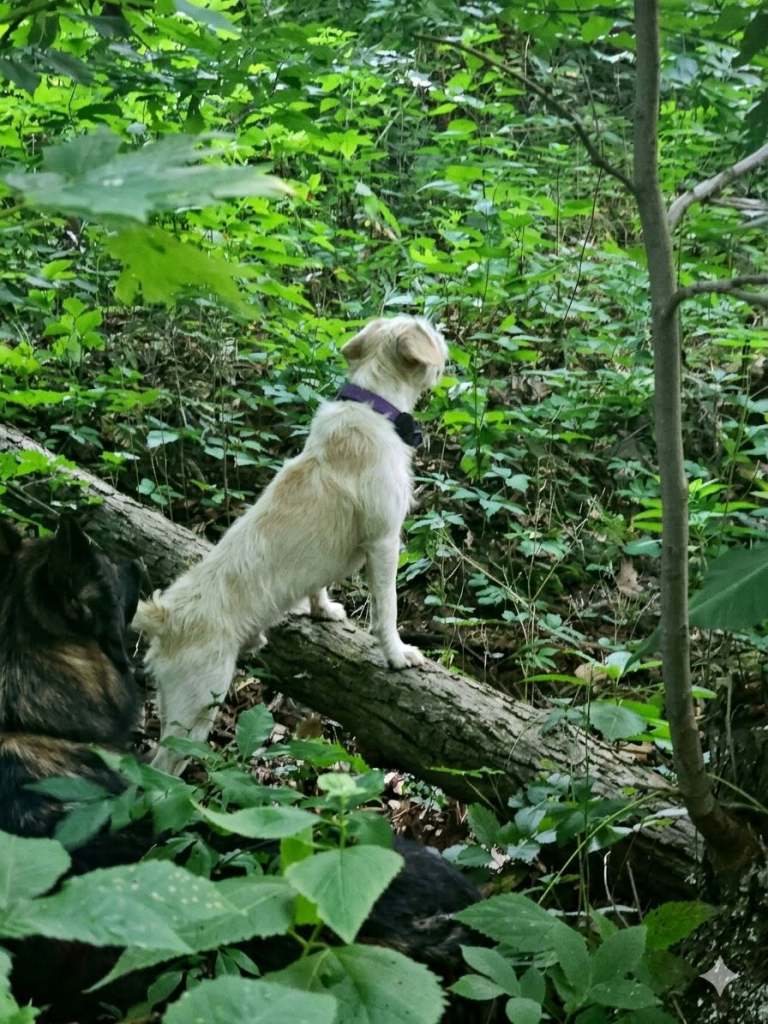
While I cannot ask Pippin about his life before I got him, I did make a few observations in those first weeks. First, he had no issues relieving himself in his crate. This is often the case with a dog that has learned there are no other options.

In the first week if he peed or pooped in the house, he would do it as far away from me as physically possible. This most likely means he was punished for peeing and pooping in front of or near a person. When we yell at a dog for peeing in front of us, we think we are telling the dog to pee outside, but what we are really telling him is not to pee where we can see it. This is why dogs go to hide when they eliminate in the house, they associate us yelling with not liking to watch them pee, so they accommodate us by hiding. We did not say “pee outside” only “don’t pee in front of me.”

When I would clean up a mess in the house, Pippin would start shaking and hide under something. Most likely this means he associated anyone cleaning up pee or poop with him getting in trouble. Again, the person most likely thought they were saying “bad dog go outside” but what they were saying is “when I clean up a mess, I will punish you right after that.”

The first thing I did was absolutely nothing other than calmly clean up any messes I found and avoid looking at Pippin. I wanted him to know I was not angry. He wasn’t eliminating in the house a lot, but it was at least once daily. It probably would have been more but I took him out almost every hour those first few days.

In a week he was peeing and pooping occasionally in the same room I was sitting in. I considered this progress. Now I could see what he was doing and what signals he might give saying he needed to pee or poop. By knowing his signals, I could more quickly allow him outside. This way he can learn to communicate if he wants to go out.

He also would pee if I left the house for a few minutes. I would come in and find pee right at the doorway where I had left the house. I am sure this was anxiety on his part. Likewise for the first few weeks I had him, he would pee and/or poop in his crate even if I only left for an hour. Again, this was anxiety related.

Knowing WHY the dog is eliminating in areas you don’t want is important. Because how you change the behavior depends on the why.

I also had a fecal done on Pippin in the first few days I had him. He tested positive for giardia, which is a tiny, single-celled parasite that infects a dog’s small intestine. Dogs get sick by swallowing the parasite from dirty water, soil, or poop. Just like with people, if the dog has an intestinal issue there may be more urgency to their need to eliminate. Being angry at a sick dog for not making it outside in time is certainly not fair to the dog.

Mainly what Pippin needed was time. He needed time to adjust to my home. He needed time to adjust to my schedule and to trust me.  He needed time to get rid of the giardia.

At about three weeks he no longer peed when I walked out the door. He also kept his crate clean for several hours at a time when I left him.

Most importantly now, in week 5, there have been zero eliminations inside the house even when he is loose at night. So far, we are four days in a row of no in-house elimination.

I didn’t do any huge elaborate protocols (although those can be necessary and beneficial); instead, I just gave him time to decompress and a LOT of opportunities to go outside. At first, I praised him profusely when he eliminated outside, but that seemed to make him nervous. So, now I just say, “good boy” calmly. Moving toward him to give him a food reward for outdoor elimination also didn’t work because he associated me moving toward him after he eliminated with punishment. (I think).

Do I think he is completely “housebroken?” Nope. I think we are on a good path and that he will keep getting better though.

When you get a new pet; don’t expect immediate perfection. The animal does not speak your language or know your customs. He may have had bad experiences in the past or he may be ill. Empathy and kindness can go a long way.

You don’t have to do everything on the first day you bring a new dog home

It seems when we get a dog, we want to take it everywhere and do everything with it all at once. People have heard “you need to socialize your dog” but like many words in training and behavior most people don’t really know what that means. We often end up doing way too much too fast with those new dogs.

Pippin

I just got a new dog so here is a recap of our first four weeks together. His name is Pippin and he is approximately 1 year old. He was surrendered to the shelter as “found as a stray.”

I thought I would share what we have not done together in that time:

  • We have not gone to a big box store to walk around and meet people.
  • We have not gone into town and walked around
  • We have not met all my friends, neighbors or relatives
  • We have not started any formal training classes or programs
  • We have not gone on long drives to get a Pup Cup or go through a drive through.
  • We have not left my property except for two veterinary visits and one brief visit to a friend. And that visit happened on the same day as one of the vet visits.

So, what have we done?

We  got to know each other better. It takes time to learn a dog’s personality. What does he like? What scares him? If something scares him, does he recover quickly or is it something that could stay with him for awhile (or a lifetime)?

He needs to get to know me. Am I safe? Am I likely to suddenly punish him or yell at him? What happens if he does something I might not be a fan of? What are my routines? Where does he go to the bathroom? When does he go to the bathroom? When is food time? Who else lives with me and are they safe?

I want Pippen to know I am safe; that he can trust me to have his back and that if he comes to me when I call him, I will have a big party (my most important goal for any dog is for it to want to come back to me).

Learning is always happening; so, if I see Pippin do something I know I want to reinforce (such as look back at me on a walk) I praise him or give him a treat. He offers me behavior the entire time he is awake. Training doesn’t happen at formal times; it is always happening. I just need to notice when the things I want are happening more so they get rewarded more.

He is an adolescent and has many typical adolescent behaviors such as “I want to grab your hand and bite you and shake you.” If he does that game, I remove my hands or I get up and walk away from him. If he jumps on my lap and does not bite my hands, I let him stay and he gets petted. In four weeks, we have gone from almost constantly chomping on my hands to rarely chomping on my hands.

We are working on the things that are important to me and my lifestyle with my dogs. I live in a very rural area and my dogs are off-leash when we go for walks. They are going to see deer, turkeys, raccoons, etc. I drive a Ranger Polaris around the farm and my other dogs enjoy going places in the Ranger.

Because I am working on building trust in our relationship, it allows Pippin to not be so worried about trying new things such as jumping into the Ranger. If we find something he isn’t excited about; we don’t have to do it. If it is important I will find a way to see if he would like to learn to do it.

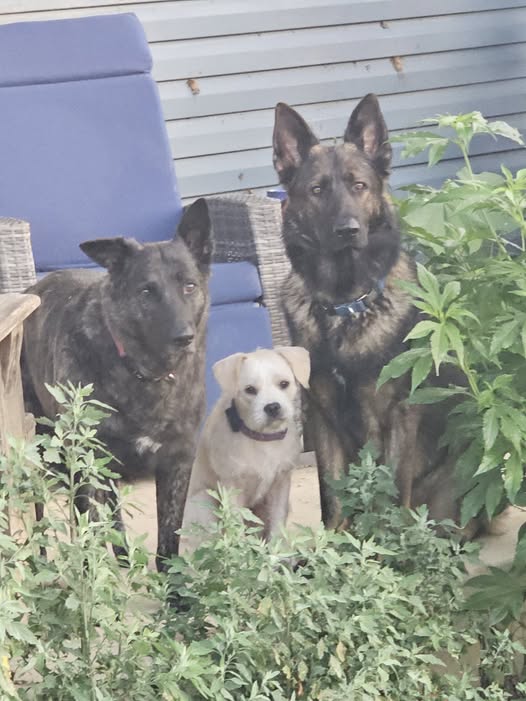
Pippin shares my home with two other dogs: Scout (3) and Skywalker (10). Both are about 60 pounds heavier than Pippin and much taller. There are also cats in the house and out in the barn.

The introductions between Scout and Pippin have taken the longest. For the first 24 hours Scout would growl and raise his hackles and curl his lip at Pippin. If given the opportunity he would chase Pippin and pin him to the ground (definitely not good when a 90-pound dog is pinning a 28-pound dog to the ground.). Not only did I need to keep Pippin on a leash outside but I also had to leash Scout so I could control him  if he tried to grab Pippin. Not an easy thing for a person to do alone. But we were only doing very brief intros. Most of the time Pippin and Skywalker (who were ok together) would be in one small, fenced portion of my yard while Scout was on the other side of the fence. When everyone was calm, I would put Scout on leash and let Pippin into the large part of the fenced yard. After a few encounters I was confident Pippin would not do anything to Scout, I just needed to make sure Scout didn’t hurt Pippin.

I also had to keep them all separated when they were in the house. So, for two days I rotated who was out. Either Pippin and Skywalker could be loose while Scout was crated or Skywalker and Scout could be loose and Pippin was crated.

Those first 48 hours were stressful because I was not sure it would work out. Scout was more intense than I had anticipated he would be. His only goal seemed to be to chase Pippin and pin him to the ground while growling in his face.

Luckily by the fourth day, Scout was far more interested in playing with Pippin and I was able to let them loose (dragging long leashes) in the fenced area of the yard. I kept Skywalker in the house in the beginning because he tends to get angry at anything he considers inappropriate play (which is anything that comes near him).

On the fourth day I was also able to let all three dogs loose in the house for up to an hour at a time. I would try and stop the play while it was still fun and before it got over the top. I would give each of the dogs long breaks away from each other.

Day five we were able to go on a walk around the barn lot with Pippin dragging a long leash (I wasn’t sure at this point what he would do if he had the opportunity to leave).

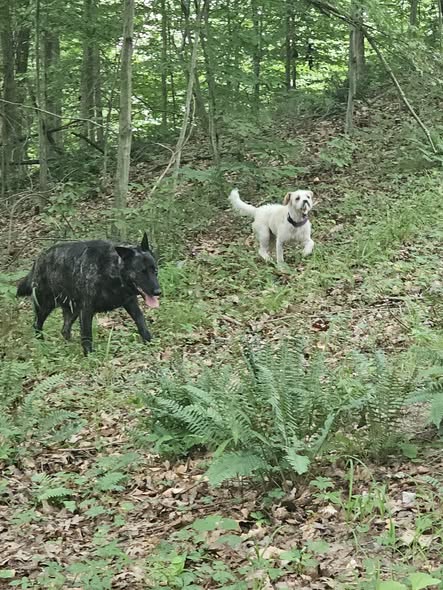
Pippin and Scout are now good friends.

Gradually things improved. Four weeks in my main worry is Scout will accidently injure Pippin. They LOVE playing together now (as in let’s play 24/7) but sometimes Scout gets too keyed up and will have a little too much fun pouncing on Pippin.

Pippin loves to be with me so I now let him loose on our walks. He is wearing a GPS collar so I can track him if he gets lost. He will follow the big dogs when they chase something, but he is also very quick to come back if I call him.

He now knows if we walk toward the Ranger he must jump in fast to get a good seat on the bench as the last dog in has to sit on the floor. He isn’t afraid of getting wet in the creek, running through a beanfield (even though the beans are taller than he is) and he isn’t that interested in chasing the barn cat.

It took a week of very slow intros before I felt safe letting Scout and Pippin play

My nephew was doing some yard work for me so I let Pippin out to meet him and Pippin was delighted. A person came to do maintenance on my generator and I took Pippin with me when I went to talk to the man. When I went back to the house I noticed Pippin wasn’t with me, he was sitting on the ground watching the man work on the generator. I didn’t make a big deal out of either of these encounters. It was just “oh hey, look someone is here.”

His last round of vaccines is next week and we will start going into town for small adventures. Because he was a dog of unknown history, I did not want to chance exposing him to Parvo and Distemper until he was fully vaccinated. He probably would have been fine since he is an adult and he had one round of vaccines, but I didn’t want to take any chances.

Just remember it can be just as important what you don’t do with your dog as it is what you do with him. Go slow, get to know each other before exploring the big, scary world. Keep in mind learning is always happening and what you do with the naturally occurring behaviors will either make them happen more often or cause them to disappear. You just have to notice them and reward what you want and ignore what you don’t want.

All three dogs together: Skywalker, Pippin and Scout